
AutoControl: An end-to-end fully automated workflow for control design of building energy systems
📌 Overview
Developing efficient and effective control systems is critical for enhancing indoor environment quality and achieving carbon neutrality goals. However, the manual design process is expertise-demanding, time-consuming, and prone to errors, especially for complex, large-scale HVAC systems.
To bridge this gap, we propose AutoControl, an end-to-end fully automated workflow powered by Large Language Models (LLMs). By integrating semantic modeling (Brick) and intelligent agents, AutoControl automates the entire process from system interpretation to code generation and parameter optimization, significantly lowering the technical barrier for high-performance building control.
🚀 Key Contributions
- LLM-Based Automated Workflow: The first end-to-end framework that utilizes LLM agents to automate control logic design and code implementation for building energy systems.
- Semantic Interpretation: Leverages Brick models to provide a standardized semantic description of building assets, enabling the AI to understand complex system topologies without manual input.
- Hybrid Code-Optimization Approach: Combines the creative coding capabilities of LLMs with the rigorous numerical optimization of Particle Swarm Optimization (PSO) for controller fine-tuning.
- Zero-Shot Generalization: Demonstrates the ability to generate effective controllers for diverse HVAC configurations without task-specific retraining.
🛠️ System Architecture & Methodology
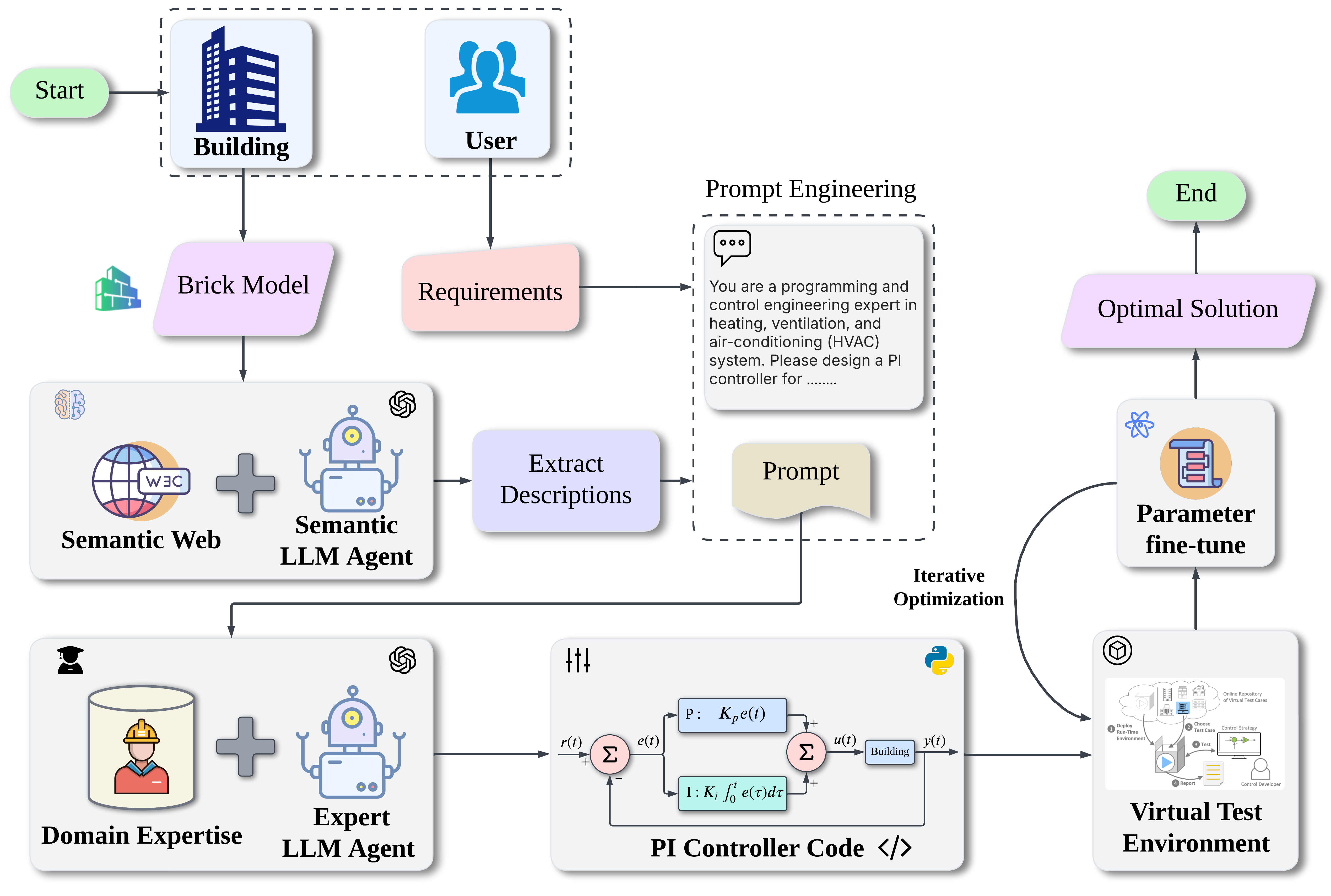 (Caption: The AutoControl workflow, integrating semantic interpretation, control code generation, and parameter optimization.)
1. Semantic Interpreter Agent
The first LLM agent acts as a bridge between structured data and control logic. It parses the Brick schema of the target building to extract equipment, control points, and operational constraints.
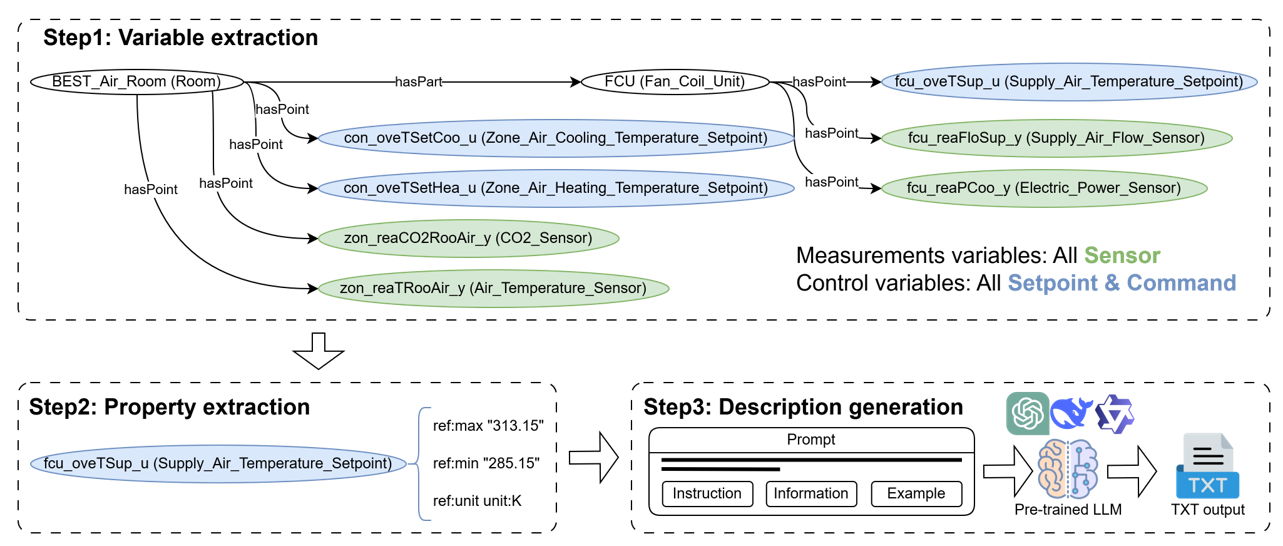 (Caption: Detailed workflow of the Semantic Interpreter Agent: Variable extraction, property extraction, and natural language description generation.)
2. Control Expert Agent
Based on the interpreted system description, the second agent generates executable control code (e.g., Python/Modelica). It focuses on:
- Designing the Proportional-Integral (PI) control logic.
- Handling multi-variable coupling in complex HVAC systems.
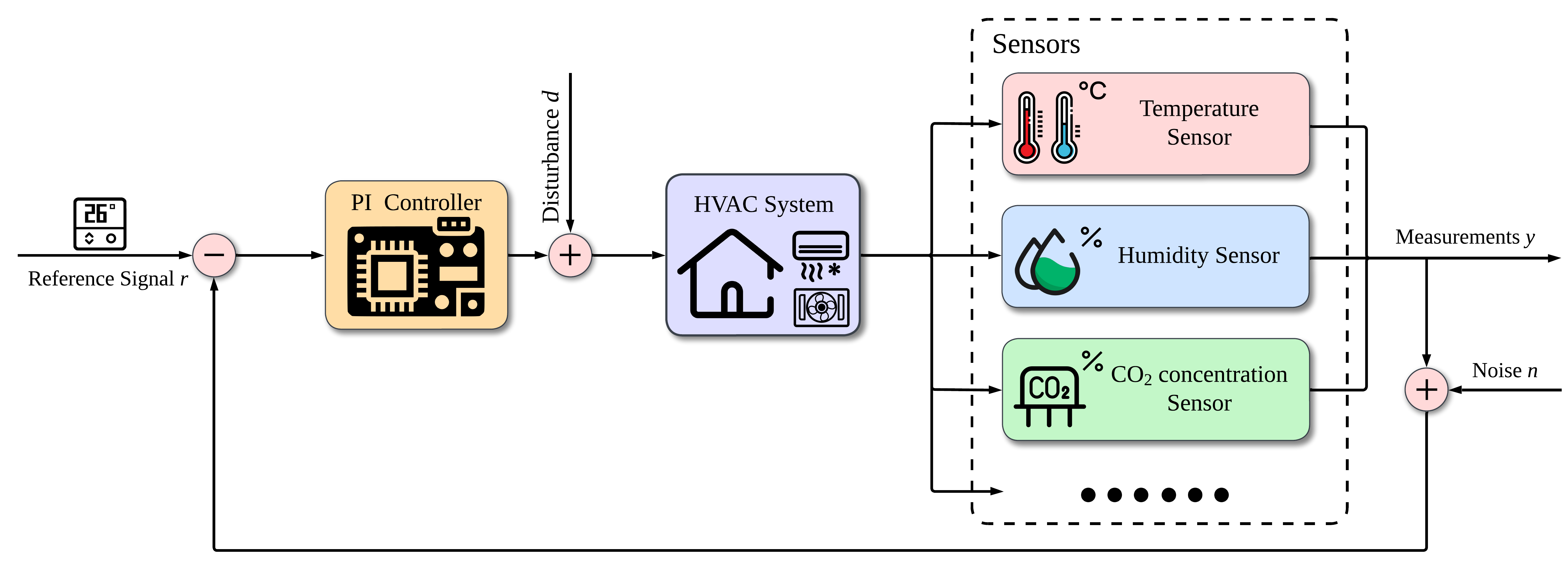 (Caption: Schematic of the PI control loop generated by the Expert Agent for HVAC systems.)
3. PSO-Based Parameter Tuning
To ensure optimal performance, we employ Particle Swarm Optimization (PSO) to automatically search for the best PI gains (\(K_p\), \(K_i\)).
- Objective Function: Minimizes a weighted sum of temperature deviations and energy consumption.
- Automation: The entire tuning loop requires no human intervention, ensuring the controller is “ready-to-use.”
📊 Experimental Results
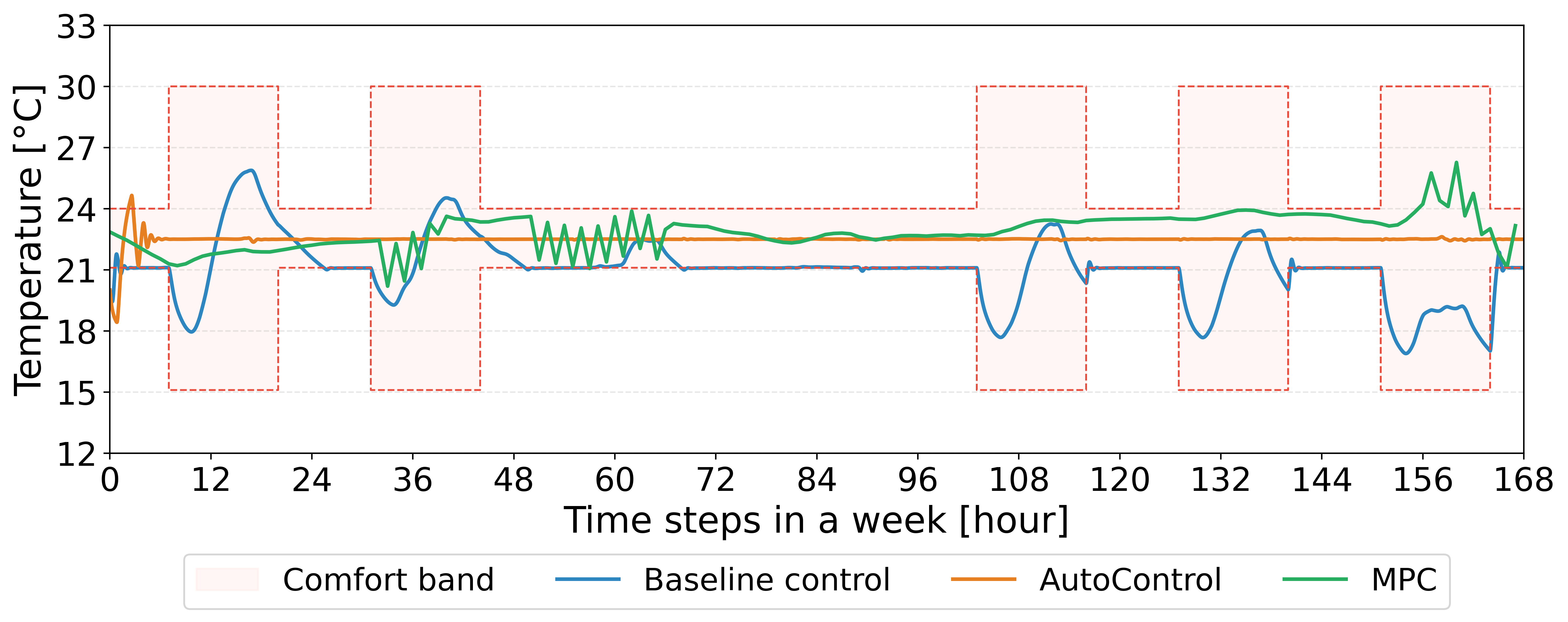
We evaluated AutoControl on the BOPTest (Building Optimization Testing Framework) virtual testbed across three different HVAC scenarios.
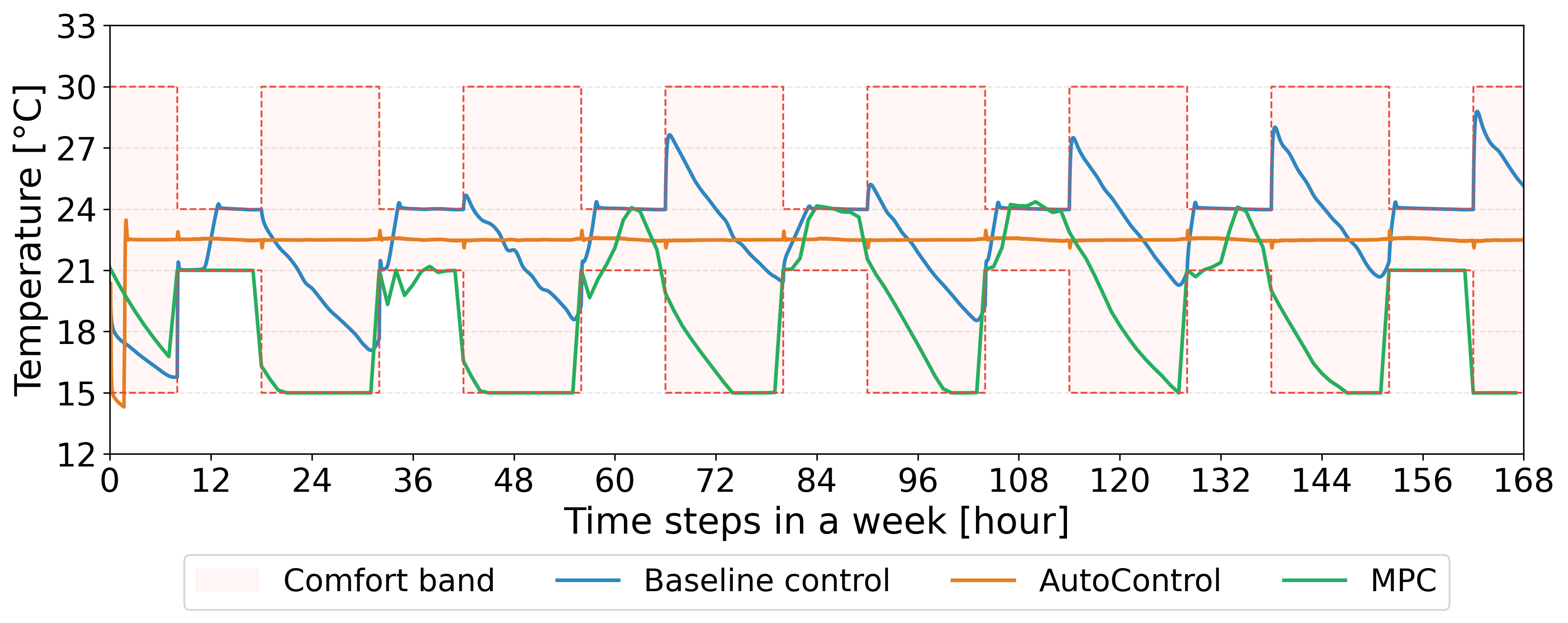
Test Case 1: Air-based
Test Case 2: Hydronic
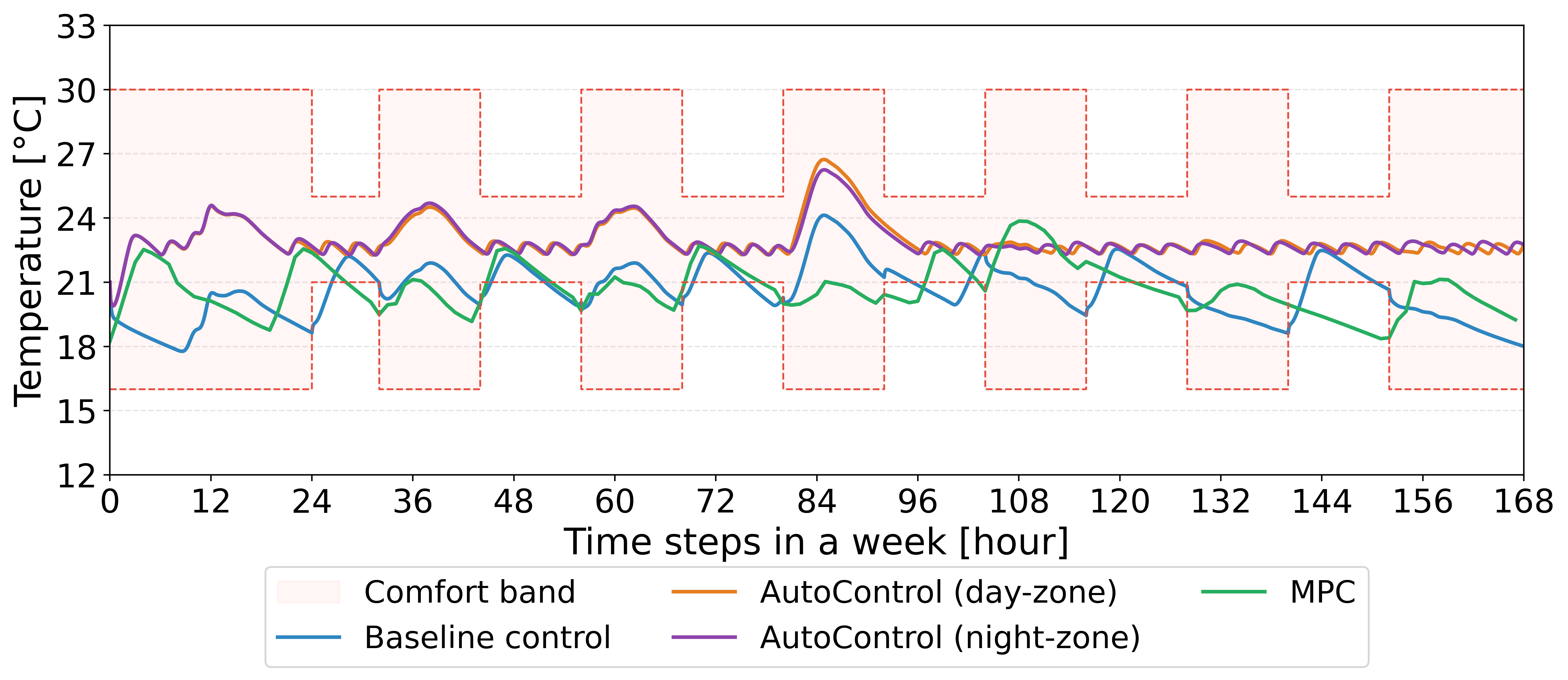
Test Case 3: Two-zone
(Caption: Temperature control performance of AutoControl compared with Baseline and MPC across three different HVAC test cases.)
1. Performance Comparison (Quantitative Results)
The following tables summarize the performance of the baseline controller, MPC, and AutoControl across three diverse test cases.
Table 1: Performance in BESTEST_Air test case
| Metrics | Baseline | MPC | AutoControl |
|---|---|---|---|
| MAE [°C] | 2.071 | 4.035 | 0.107 |
| RMSE [°C] | 2.536 | 4.871 | 0.770 |
| $$\Delta T_d$$ [Kh/zone] | 3.273 | 12.161 | 0.598 |
Table 2: Performance in BESTEST_Hydronic test case
| Metrics | Baseline | MPC | AutoControl |
|---|---|---|---|
| MAE [°C] | 1.764 | 0.969 | 0.051 |
| RMSE [°C] | 2.127 | 1.241 | 0.335 |
| $$\Delta T_d$$ [Kh/zone] | 2.759 | 2.464 | 2.609 |
Table 3: Performance in Two_Zone_Apartment_Hydronic test case
| Method | MAE [°C] | RMSE [°C] | $$\Delta T_d$$ [Kh/zone] |
|---|---|---|---|
| Baseline | 1.96 | 2.280 | 17.2379 |
| MPC | 1.007 | 1.347 | 19.110 |
| AutoControl$_d$ | 0.572 | 1.01 | 12.3171 |
| AutoControl$_n$ | 0.562 | 0.95 | - |
2. Generalization Capability
AutoControl was tested on diverse systems, ranging from simple hydronic heating to complex air-handling units, demonstrating robust performance without requiring manual adjustments to the underlying logic. The results highlight that LLM-based agents can effectively bridge the gap between semantic building models and high-performance control systems.