
AutoControl-MPC: An automated model predictive control development framework based on large language models for HVAC systems
Published in Energy and Buildings, 2026
Paper (Energy and Buildings, 2026)
📌 Overview
HVAC systems account for a large share of global energy use. Model Predictive Control (MPC) handles their dynamics and uncertainty well, but building an MPC controller is labor-intensive and needs specialist knowledge. Each building needs its own model identification and code, which limits MPC adoption at scale.
AutoControl-MPC automates every stage of MPC development with large language models (LLMs). It extends our earlier AutoControl workflow from rule-based control design to model predictive control.
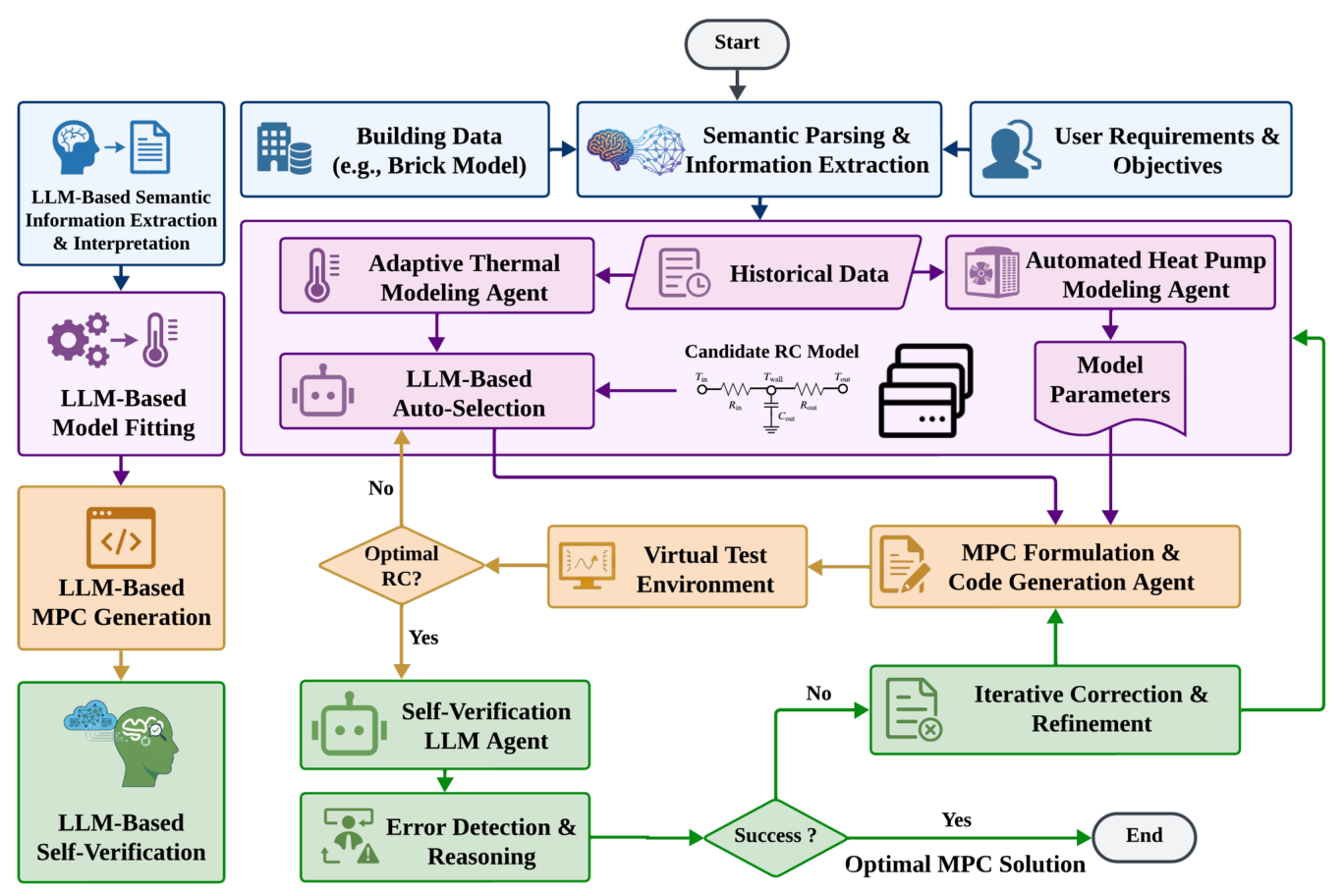 Overview of the AutoControl-MPC workflow: semantic information extraction, LLM-based model fitting, MPC generation and self-verification.
🚀 Key Contributions
- End-to-end automation: Each step of MPC development, from understanding the system to generating controller code, runs without manual intervention.
- Template-driven pipeline: LLMs follow deterministic decision rules to parse semantic building information (e.g., Brick models), identify system models and generate control code.
- Automatic RC model selection: The LLM generates fitting scripts for candidate RC models (1R1C to 5R4C), tests each one in closed loop and picks the best model from KPIs and user requirements.
- Self-reflective verification: An LLM agent reads the simulation logs, locates the faulty module and sends revision instructions back to it until the controller passes.
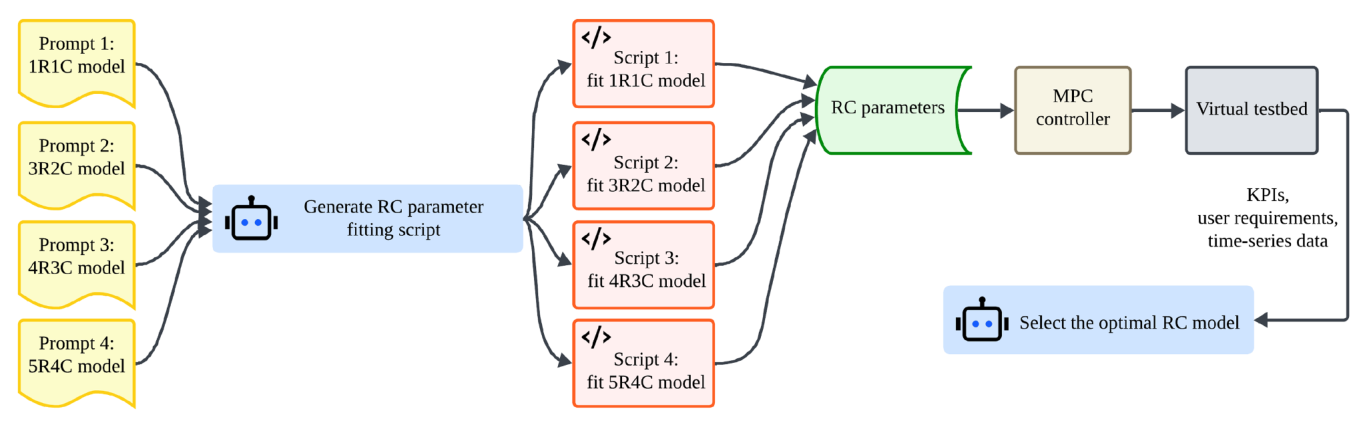 LLM-based auto-selection of the RC thermal model.
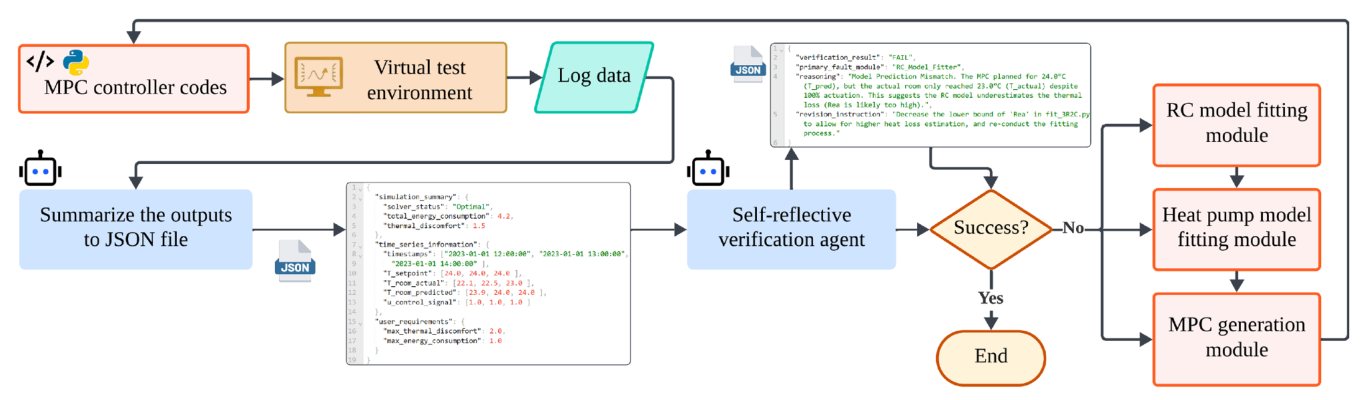 Self-reflective verification: simulation outputs are summarized to JSON, checked by the verification agent, and errors are routed back to the responsible module.
📊 Results
The framework was evaluated on two BOPTest virtual test cases: a residential building with a hydronic heat pump (BESTEST_hydronic_heat_pump) and a single-zone commercial building with a hydronic system.
| Test case | Controller | Thermal discomfort (Kh/zone) | Energy cost ($/m²) |
|---|---|---|---|
| Hydronic heat pump | Baseline | 2.96 | 0.41 |
| Manual-MPC | 0.11 | 0.31 | |
| AutoControl-MPC | 0.00 | 0.38 | |
| Commercial hydronic | Baseline | 0.12 | 0.14 |
| Manual-MPC | 0.16 | 0.13 | |
| AutoControl-MPC | 0.11 | 0.13 |
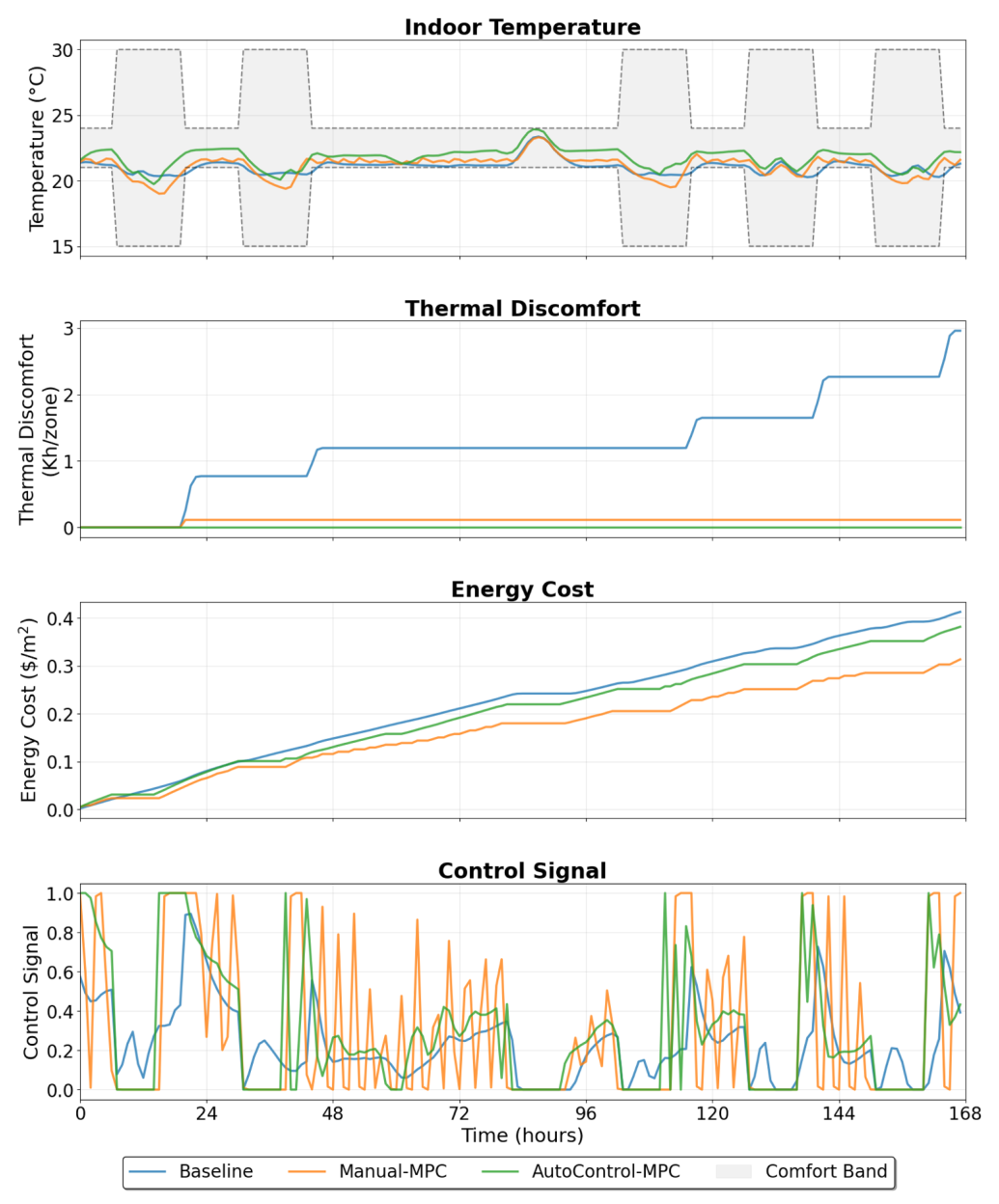 Control results in the BESTEST_hydronic_heat_pump case: indoor temperature, thermal discomfort, energy cost and control signal.
Self-verification raised the success rate of generating a working controller from 58% to 82% in the heat pump case, and from 40% to 66% in the commercial case.
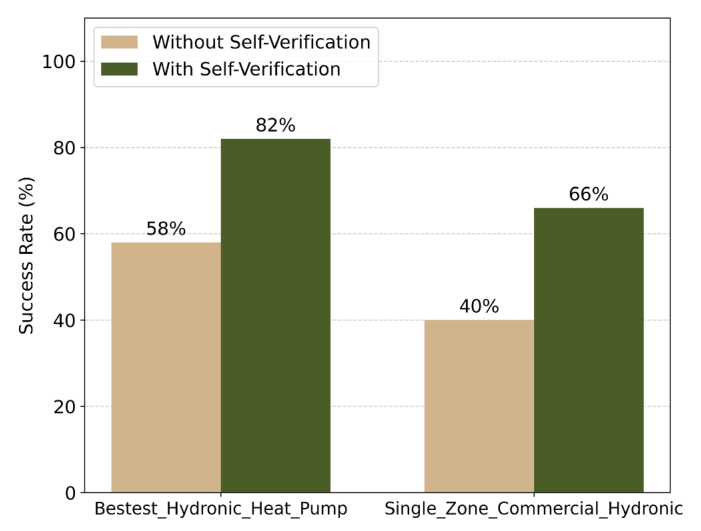 Success rate with and without self-verification.
AutoControl-MPC achieves control performance comparable to, and in some cases better than, an expert-developed MPC controller. The results show that LLMs can automate control development for complex building energy systems.
Figures reproduced from Hu et al., Energy and Buildings, 2026.